Localizing the women, peace and security agenda through community-based mechanisms in Thailand
Source: UN Women
Adopted in 2000, UN Security Council resolution (UNSCR) 1325 recognizes women’s critical role in preventing and resolving conflicts, peacebuilding, peacekeeping, humanitarian response and post-conflict recovery, and calls for their equal participation and leadership in such efforts. UN Women has been advancing the women, peace and security (WPS) agenda in Thailand for more than a decade, with its work initially rooted in the Southern Border Provinces of Pattani, Yala and Narathiwat. In these areas, women’s groups, women-led civil society organizations (CSOs) and non-governmental organizations (NGOs) have played a pivotal role in empowering women, fostering social cohesion, and creating safe and inclusive spaces where women can learn, exchange experiences, strengthen their capacities and raise their voices on issues affecting their communities. These community-based initiatives have demonstrated the vital contribution of local women leaders and organizations in promoting peace, security, resilience and sustainable development.
Through UN Women’s long-standing partnership with national and local stakeholders – particularly the Department of Women’s Affairs and Family Development (DWF) under the Ministry of Social Development and Human Security, and the Southern Border Provinces Administrative Centre – Thailand adopted the Measure and Guideline on Women, Peace and Security in 2017, marking its first policy dedicated to advancing the WPS agenda. Building on this foundation, in December 2025, Thailand endorsed its first National Action Plan on Women, Peace and Security (WPS NAP).
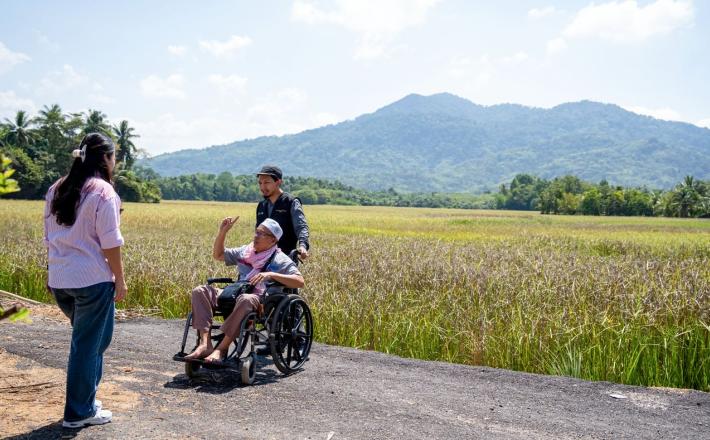
Adopted in 2000, UN Security Council resolution (UNSCR) 1325 recognizes women’s critical role in preventing and resolving conflicts, peacebuilding, peacekeeping, humanitarian response and post-conflict recovery, and calls for their equal participation and leadership in such efforts. UN Women has been advancing the women, peace and security (WPS) agenda in Thailand for more than a decade, with its work initially rooted in the Southern Border Provinces of Pattani, Yala and Narathiwat. In these areas, women’s groups, women-led civil society organizations (CSOs) and non-governmental organizations (NGOs) have played a pivotal role in empowering women, fostering social cohesion, and creating safe and inclusive spaces where women can learn, exchange experiences, strengthen their capacities and raise their voices on issues affecting their communities. These community-based initiatives have demonstrated the vital contribution of local women leaders and organizations in promoting peace, security, resilience and sustainable development.
Through UN Women’s long-standing partnership with national and local stakeholders – particularly the Department of Women’s Affairs and Family Development (DWF) under the Ministry of Social Development and Human Security, and the Southern Border Provinces Administrative Centre – Thailand adopted the Measure and Guideline on Women, Peace and Security in 2017, marking its first policy dedicated to advancing the WPS agenda. Building on this foundation, in December 2025, Thailand endorsed its first National Action Plan on Women, Peace and Security (WPS NAP).